The plots below are built using R’s ggplot2. The code is available on my Github
Problem formulation
Let \( X \) and \( Y \) be two independent random variables. Let us assume that their sum is big, i.e larger than a given number \( a \) (or equivalently, their mean): \( X + Y \geq a \). Under this assumption, is only one of them likely to be very large, or both moderately large ?

Gauss’s answer

If the pair \( (X, Y) \) is normally distributed, then both \( X \) and \( Y \) are likely to be large at the same time. In order to understand why, let us look at the contour lines of the \( (X,Y) \) pair’s density. For each point belonging to a given contour line, the density of the pair \( (X,Y) \) is equal to a constant \( C \in \mathbb{R} \). In this case, assuming \( X, Y \sim \mathcal{N}(0,1) \), then the multivariate density is: $$f(x) := \frac{1}{2 \pi} e^{-\frac{x² + y²}{2}}$$ Hence, for a given constant \( 0 < C \leq \frac{1}{2 \pi} \): $$f(x) = C \Leftrightarrow x² + y² = -2 \log (2 \pi C) := C’$$ This equation shows that the contour lines of a two-dimensional normal distribution are circles. Here is the contour plot:
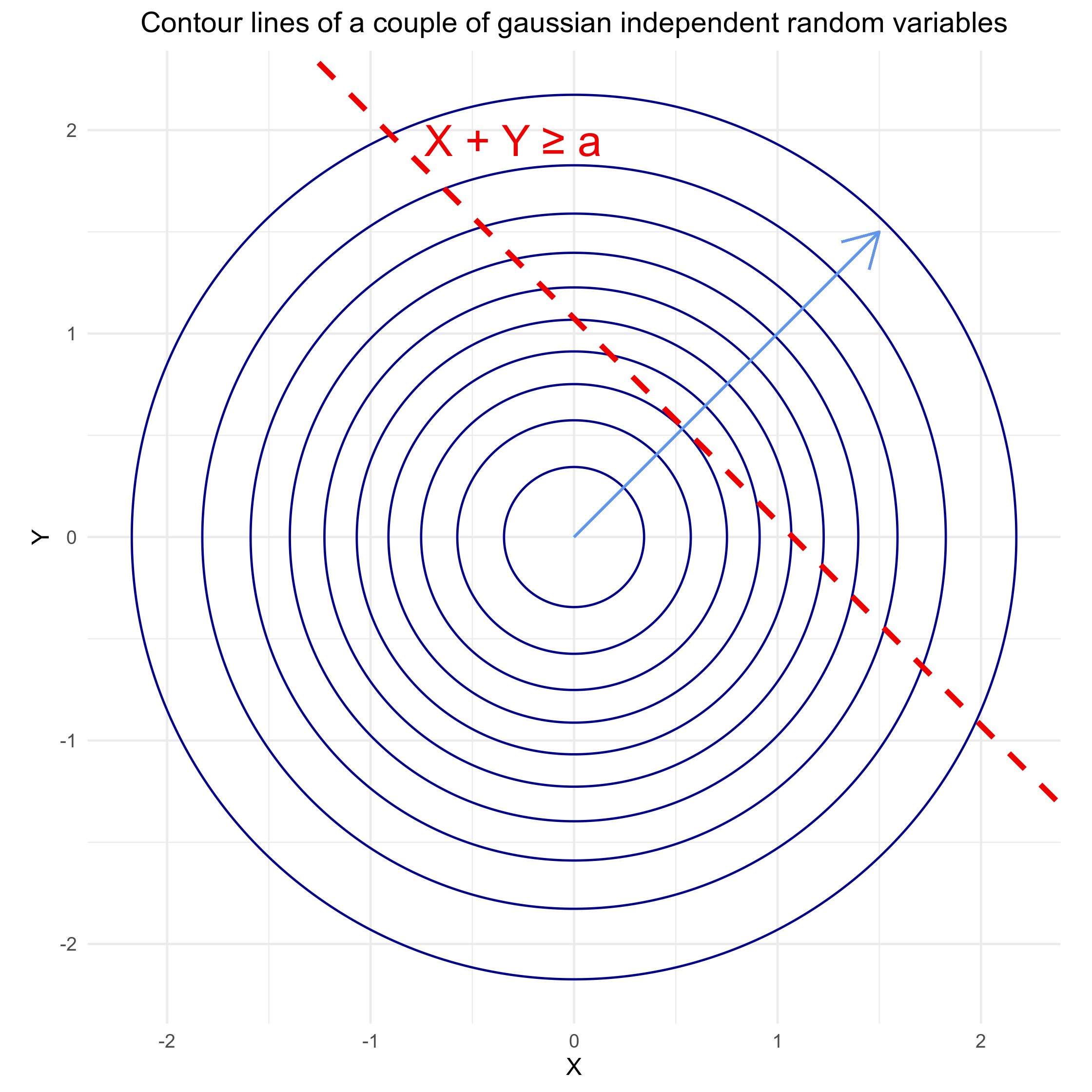
We can see that the point belonging to the domain \( \{ x + y \geq a \ | \ (x, y) \in \mathbb{R} \} \) with the highest density is on the line represented by the equation \( y = x \). In other words, if
\( X + Y \) is large, then most likely both \( X \) and \( Y \) are large.
Cauchy’s answer

If the pair \( (X, Y) \) is Cauchy-distributed, then having either \( X \) large or \( Y \) large is more likely than having both \( X \) and \( Y \) large. Suppose that \( X, Y \sim \mathcal{C}(0,1) \) (“standard” Cauchy distribution with location 0 and scale 1, obtained by dividing two gaussain independent variables). Then the multivariate density is: $$g(x):= \frac{1}{\pi²} \frac{1}{(1+x²)(1+y²)}$$ Below are the corresponding contour lines:
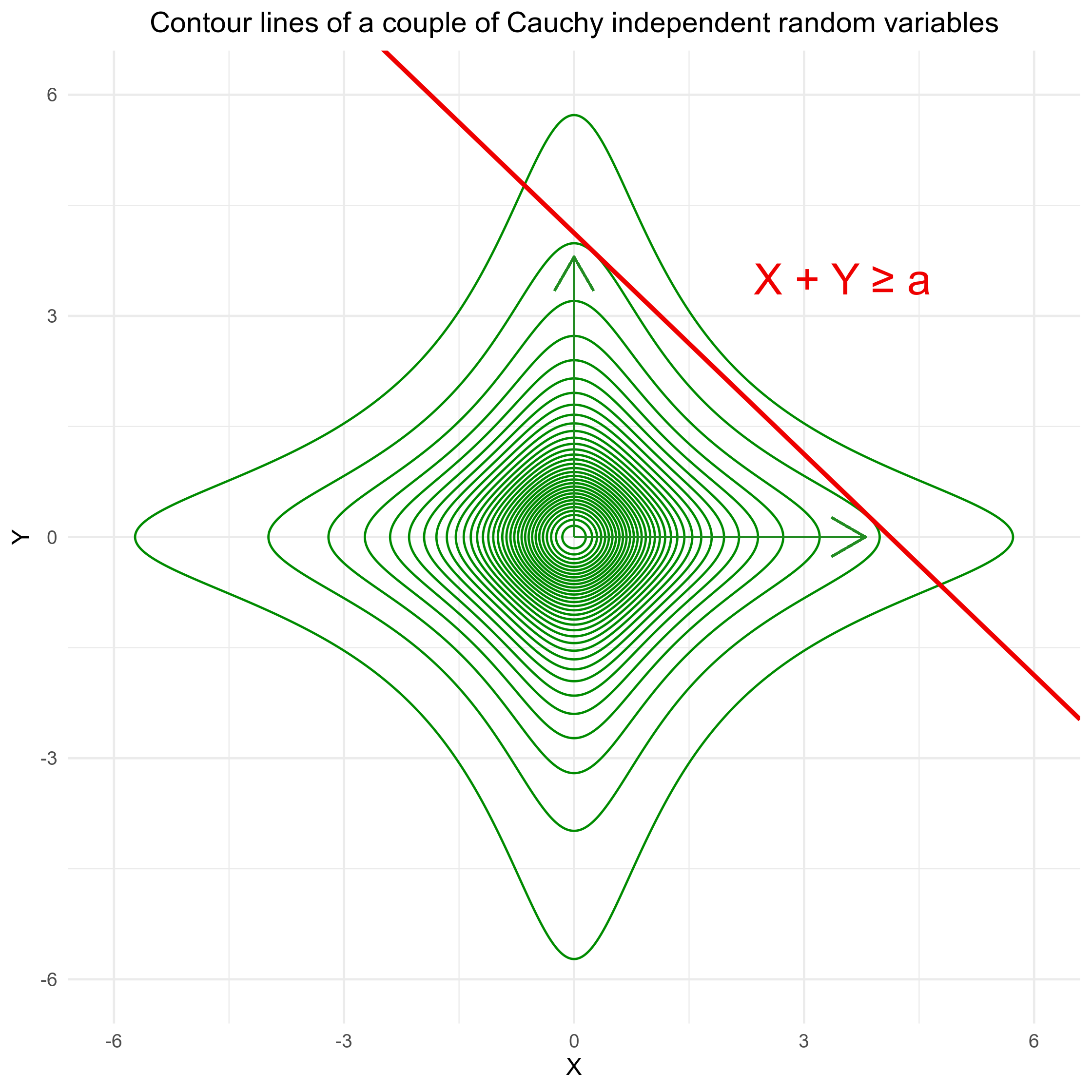
in this case, we can see that there are two points belonging to the domain
\( \{ x + y \geq a \ | \ (x, y) \in \mathbb{R} \} \) such that the probability density is highest: one close to the X-axis and one close to the Y-axis. Put differently, if \( X + Y \) is large, then most likely either \( X \) is large and \( Y \) small, or vice versa.